Processes meetings up to 90 minutes in English and German, generating AI transcripts and summaries with PII masking, configurable 1-day to 1-year data retention, corporate SSO, and automated audio/video processing.


.svg)
Employees needed a secure way to turn recorded meetings into searchable transcripts and concise summaries without manually reviewing long recordings or exposing personally identifiable information contained in business conversations.
.svg)
The PoC had to support Windows 10/11, 90-minute recordings, English and German speech, corporate SSO, automatic PII removal and strict data retention while keeping cloud infrastructure and AI-processing costs low.
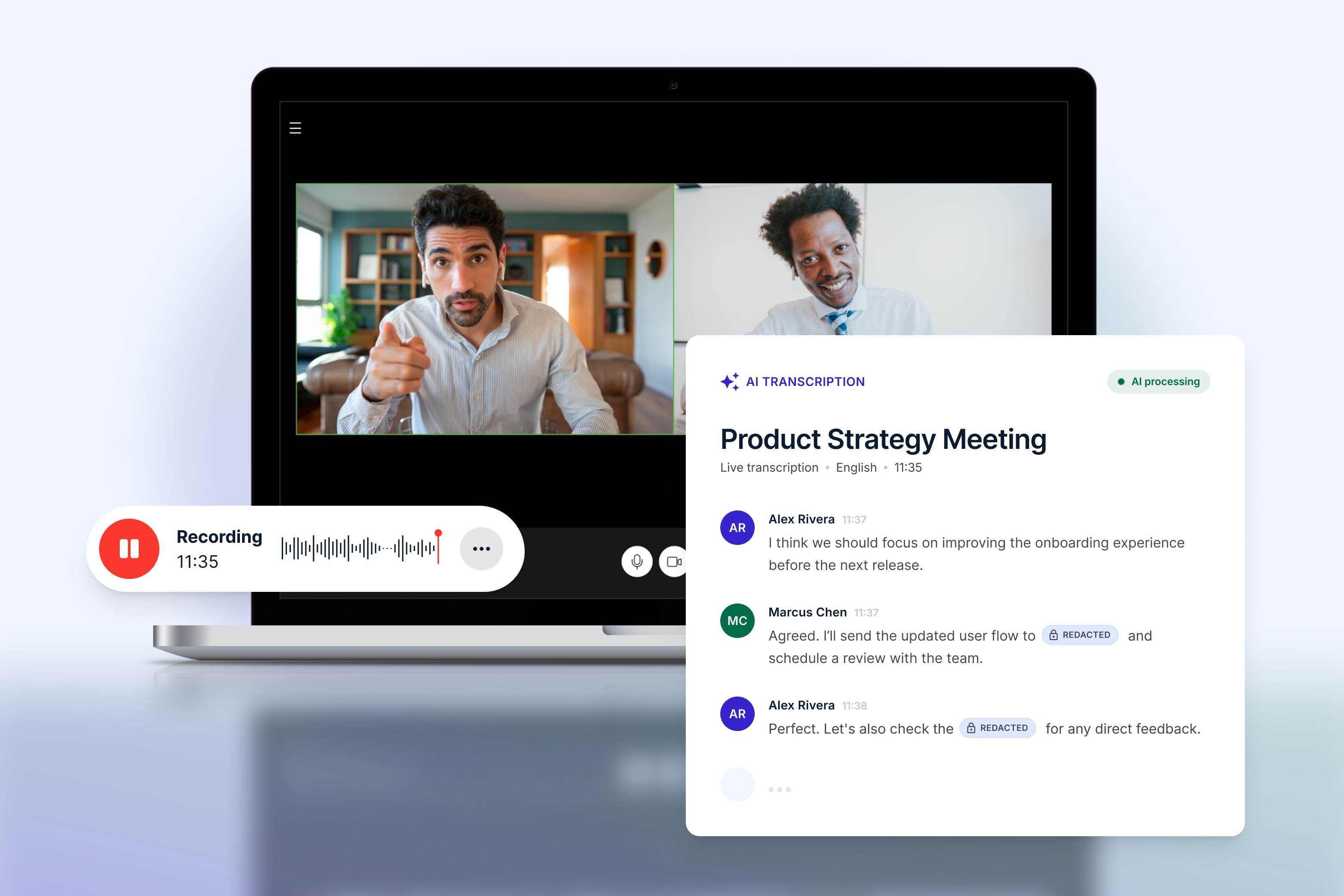
We designed and implemented a privacy-focused AI meeting processing application that transforms recorded business conversations into structured transcripts and concise summaries while automatically removing personally identifiable information.
The solution was created for employees who regularly work with recorded meetings and need to extract useful information without manually replaying lengthy audio or video files. Users interact with a lightweight Windows desktop application where they authenticate using their existing corporate Microsoft identity and upload meeting recordings in common audio or video formats.
Once uploaded, recordings enter an asynchronous cloud processing pipeline. Audio and video processing, speech recognition, privacy filtering and AI summarization are executed as separate stages, allowing computationally intensive operations to run in the background without requiring the desktop application to remain blocked while processing takes place.
The platform supports recordings of up to 90 minutes and processes conversations in both English and German. Automatic speech recognition converts the meeting into a textual transcript, after which AI models generate a condensed summary designed to surface the most important information from the conversation. The resulting transcript and summary are made available through the desktop application as downloadable text files.
Privacy was one of the central architectural requirements. Meeting recordings can contain names, contact information and other personally identifiable information that should not appear in generated documents. We therefore designed an additional processing stage responsible for identifying and removing sensitive information before transcription and summarization results are presented to users. Different speech-recognition approaches were evaluated based on accuracy, processing cost and native support for sensitive-data redaction.
The application provides employees with a historical library of processed recordings, including recording metadata and access to the generated transcript and summary. Individual records can be opened, downloaded or manually removed directly from the application.
Data lifecycle management was also built into the solution. Original recordings and temporary derived media files are stored only for a configurable retention period and are automatically removed when that period expires. Retention can be adjusted from as little as one day to as long as one year, allowing the organization to align storage behaviour with its internal privacy and compliance policies.
On the backend, we designed a serverless, event-driven architecture for asynchronous media processing. Cloud object storage handles large recording files, while queued background jobs coordinate media conversion, transcription, privacy processing and summarization. This approach avoids maintaining permanently running compute capacity for workloads that are naturally bursty and computationally intensive.
We also evaluated several AI transcription technologies and architectures before implementation, comparing processing costs, privacy capabilities and operational limitations. The selected approach combined cost-efficient speech recognition with a separate language model for summarization, while preserving the ability to switch transcription providers where stronger native PII-redaction capabilities were required.
The result was a lightweight proof-of-concept demonstrating how enterprise meeting recordings can be transformed into useful AI-generated knowledge while treating privacy, data retention and corporate access control as fundamental parts of the workflow rather than additional features.


